


Finding somewhere to stay for a group of six or more people is one of the most consequential decisions you'll make for any group trip. Get it right and the accommodation becomes the social hub of the holiday — a place where the group naturally gathers, has dinner together, and debriefs the day over drinks. Get it wrong and you'll spend the week frustrated by noise, awkward bathroom queues, and a location that means you need three taxis everywhere.
The right choice depends on your group size, your budget, your destination, and what kind of trip this actually is. Here's how to think through the options.
Option 1: A large Airbnb or villa rental
For groups of 5 to 12, renting an entire property is often the most social and cost-effective option. Everyone is under one roof, there's usually a kitchen (saving money on meals), and you get the experience of living in a real neighbourhood rather than a hotel corridor.
The sense of togetherness is the biggest draw — shared living spaces create natural group moments that a block of hotel rooms simply doesn't. A kitchen cuts food costs significantly, and a full property is often cheaper per head than booking equivalent hotel rooms. You get more space and more privacy than a hostel.
The trade-offs are real though. One person has to hold the booking and take responsibility for the deposit — that's a meaningful liability. Property damage disputes with Airbnb can be stressful. Check-in logistics can be complicated (key boxes, host contact, coordinating 8 people arriving at different times). And if the location is wrong, you're stuck with it for the whole trip.
What to look for in reviews: search specifically for mentions of whether the property matched its photos, whether the host was responsive, and whether previous guests had any deposit disputes. Listings with fewer than 20 reviews carry more risk for group bookings where the deposit size is significant.
Option 2: Hotels with multiple rooms
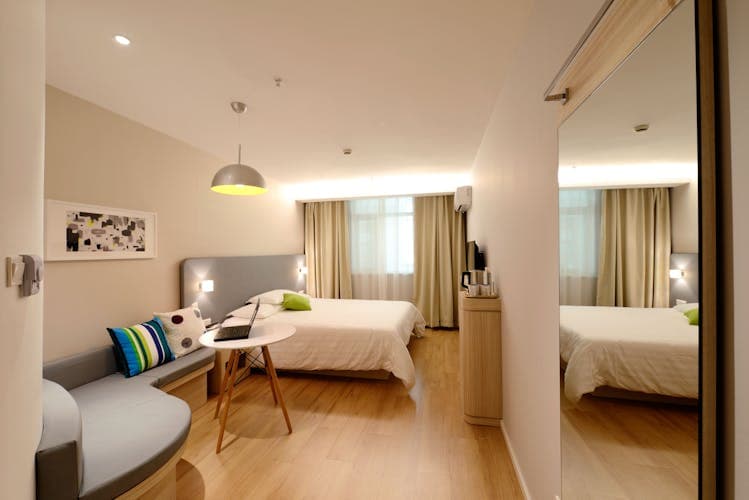
Booking adjacent rooms in the same hotel gives everyone private space while keeping the group together. For groups that prioritise sleep quality, reliability, and not dealing with shared-kitchen politics, hotels often make more sense than the alternatives.
The consistency is the main selling point — you know what you're getting. No deposit liability (individual rooms, individual responsibility). Easy to escalate issues to reception. Hotels tend to be centrally located in city-break destinations, and breakfast packages can simplify the morning logistics considerably.
The downside is cost. Hotels are almost always more expensive per head than an equivalent Airbnb, and rooms can end up scattered across multiple floors with no communal space. With no kitchen, every meal is a purchasing decision. There's also a certain feeling of being a group of individuals in adjacent rooms rather than a group in a shared home — which matters more for some trips than others.
For city trips where you're out most of the day and the accommodation is mainly for sleeping, hotels are hard to beat on convenience. For trips where the accommodation itself is part of the experience — a week in the countryside, a beach holiday — a self-catering property usually wins.
Option 3: Hostel with private rooms
Modern hostels have evolved significantly from the dormitory-heavy backpacker model. Many now offer private rooms with en-suite bathrooms, communal kitchens, and social spaces — at prices well below comparable hotels.
For groups of younger travellers on tighter budgets, booking a block of private rooms in a well-reviewed hostel can be an excellent middle ground. The shared common areas work well for groups who want to mix with other travellers, and there's usually no large deposit required.
The honest trade-offs: room quality varies more than hotels, shared bathroom facilities still exist in some properties, and the experience can feel impersonal compared to renting a whole property. Hostels work best for short city breaks where the group will be out most of the time and simply needs somewhere clean, central, and affordable to sleep.
Option 4: Boutique guesthouses and B&Bs
In some destinations — rural France, small Italian towns, the Scottish Highlands — boutique guesthouses and B&Bs are often the most characterful and competitively priced option. Many smaller properties have 4-8 rooms, making them well-suited to a medium-sized group that effectively books the place out.
These properties often have more character than chain hotels, breakfast is frequently included, and hosts tend to provide genuinely useful local knowledge. Booking out a small property gives a private house feel with hotel service.
The limitation is obvious: this type of accommodation only exists in certain destinations. Breakfast times and house rules can feel constraining for groups who want to stay up late, and fewer rooms means less flexibility if the group expands.
How to evaluate location vs. price
The cheapest accommodation is rarely the best value if it adds significant transport time and cost to every day of your trip. A property that's 40 minutes from the city centre by public transport will cost each person meaningful time and money over the course of a week.
A useful rule of thumb: if staying centrally costs each person £15 more per night, but saves £10 per day in transport costs and an hour of daily travel time, the central option is usually worth it. Do the maths for your specific situation rather than defaulting to the cheapest listing.
Who should hold the booking?
For Airbnb rentals and villa bookings, someone in the group has to put their name and credit card on the reservation and be liable for the deposit. This is a real responsibility and it deserves acknowledgement.
Practical approaches that work: the person who holds the booking collects their share of the cost from the group in advance, before travel. Use a group payment tool or a joint account (Monzo and Starling both offer good options) so the money is sitting ready before anyone pays. Agree in writing — even just a WhatsApp message — on the cancellation policy and what happens if someone drops out.
Whoever holds the accommodation booking should not be left out of pocket if plans change. Make this agreement explicitly before anyone pays a deposit.
Cancellation policies: read before you book
For group travel, cancellation flexibility matters more than it does for solo bookings. In a group of eight, the chance of someone having to drop out between booking and travel is genuinely significant — a work crisis, illness, family emergency.
Before committing to any accommodation, check the cancellation policy in detail ("flexible" and "strict" mean very different things), understand whether a partial refund is possible if the group size reduces, and consider whether the extra cost of a more flexible rate is worth the peace of mind.
The worst outcome is booking a non-refundable property three months in advance, having two people drop out, and being stuck paying for rooms you won't use. A slightly more expensive but fully refundable option often pays for itself.